Holography is a technique which enables three-dimensional images (holograms) to be made. It involves the use of a laser, interference, diffraction, light intensity recording and suitable illumination of the recording. The image changes as the position and orientation of the viewing system changes in exactly the same way as if the object were still present, thus making the image appear three-dimensional.
The holographic recording itself is not an image; it consists of an apparently random structure of either varying intensity, density or profile.
 |
| 3D DISPLAY |
Close-up photograph of a hologram's surface. The object in the hologram is a toy van. It is no more possible to discern the subject of a hologram from this pattern than it is to identify what music has been recorded by looking at a CD surface. Note that the hologram is described by the speckle pattern, rather than the "wavy" line pattern.
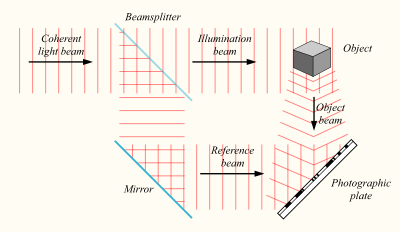
Holography is a technique that enables a light field, which is generally the product of a light source scattered off objects, to be recorded and later reconstructed when the original light field is no longer present, due to the absence of the original objects.[24] Holography can be thought of as somewhat similar to sound recording, whereby a sound field created by vibrating matter like musical instruments or vocal cords, is encoded in such a way that it can be reproduced later, without the presence of the original vibrating matter.
 |
| WORK OF HOLOGRAPHY |
 |
| COMPARISON BTW HOLOGRAPHY AND PHOTOGRAPHY |
| PHOTOGRAPHY |
| HOLOGRAPHY |
In photography, only intensity is recorded so photography produces two dimensional picture of the object whereas in holography, both intensity as well as phase of light wave is recorded, thus holography gives three dimensional picture of the object.
Negative is prepared first in photography whereas in holography no negative is required. The hologram is negative and image it gives is positive.
If the hologram is broken into parts, each part is capable of reconstructing the entire object. But in photography the destruction of even very small portion of negative or photography results in a irrepareable loss of information.
Holography has high information capacity as compared to photography.
Applications for Holography
In the past technologies have filtered down to hundreds of areas of life. In the same way 3D holography could spell sweeping changes for the future:
In the living room: bringing full color, holographic 3D images in HDTV comparable quality
With the www and computers now an every day part of so many aspects of home communications, SeeReal technology dovetails perfectly with today’s technological developments: content can be read from computer hard drives, DVD or straight off the Internet.
In the office and development departments: providing realistic images to boost business performance
SeeReal holography is ideal for CAD/CAM applications, allowing designers and engineers to convert ‘true’ 3D content into even ‘truer’ moving 3D simulations. Not only can output now be assessed in real time, but companies can also give clients life-like product demos and show samples in all corners of the globe. Standard stereo content can be converted into true holographic 3D.
PCs and game parlours
Who knows what the future holds, but with interactive applications and real-time gaming already exploding worldwide, the potential avenues for SeeReal holography to open up in this technology field could be boundless. Adventure becomes real life. Action really makes hearts beat.

No comments:
Post a Comment